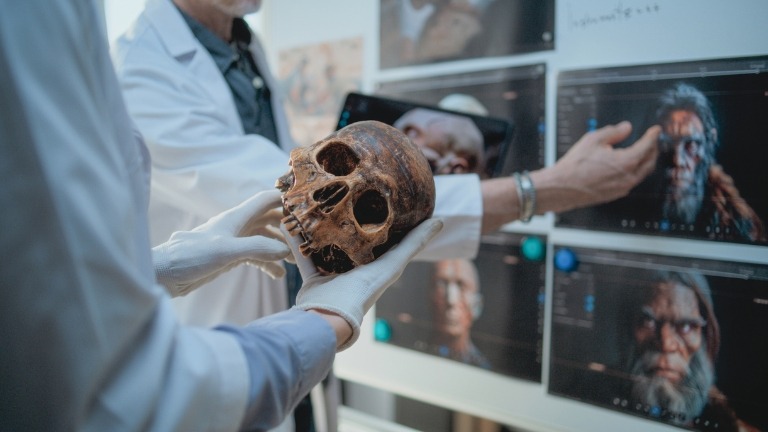

The carbon 14 dating is one of the most reliable methods for establishing the age of organic remains studied in archaeology. For over 70 years, it has enabled archaeologists to reconstruct the chronology of ancient sites, artifacts and events. Whether wood, bone, charcoal, collagen or mortar: each material requires a rigorous protocol, precise calibration and expert interpretation.
In this article, we explore the principle of carbon 14, its protocol, applications, limitations and the key role of specialized laboratories.
Scientific principles and protocol of carbon-14 dating for archaeology
The dating carbon 14 or radiocarbon analysis is an essential study that allows for the establishment of the chronology of archaeological sites and artifacts. It is crucial that professionals involved in excavations and their analysis are able to understand the scientific basis and protocol of carbon-14 analysis to optimize the interpretation of results.
The scientific principle of radiocarbon dating
The principle of carbon 14 is based on the measurement of the radioactive isotope carbon 14 (14C) contained in organic matter. During the life of an organism (plant, animal, human), the exchange of carbon with the atmosphere maintains a balance between carbon 12 (12C) and carbon 14. At death, this exchange ceases, and 14C decreases with a half-life of 5,730 years.
The carbon-14 dating method thus consists of measuring the residual 14C/12C ratio to calculate the time elapsed since the organism's death, expressed in gross age, in years BP ("Before Present", where "present" = 1954)It is important to remember that variations in atmospheric carbon 14 over time nevertheless require calibration of the results. Calibration curves, established from dendrochronology, coral, or marine sediment data, are thus used, allowing the raw age to be converted into calibrated dates.
On the other hand, modern technologies, notably gas pedal spectrometry (AMS), are highly sensitive, making it possible to carbon-14 date wood, bones, charcoal, collagen or bioapatite, even from very small samples (a few milligrams).
Analysis protocol and sampling criteria
The carbon-14 dating protocol applied to archaeology comprises several key stages:
- Sampling : a rigorous choice of material while minimizing the risk of contamination (a fundamental criterion in guaranteeing the reliability of carbon-14 dating).
- Chemical pre-treatments : sample purification to eliminate modern or old contaminants, and extraction of the material to be dated (cellulose, collagen).
- Elemental analysis, isotope measurement and graphitization : carbon and nitrogen concentration, 13C/12C isotope ratio, carbon extraction and transformation into graphite, 14C/12C ratio measurement.
- Calibration and validation of results.
The minimum sample size depends on the material and its state of preservation. For example, a few milligrams are sufficient for AMS, but preserving samples for carbon-14 dating analysis remains a major challenge, especially for weathered materials.
In this respect, collaboration with a recognized carbon-14 laboratory, such as CIRAM, guarantees compliance with international standards, strict sampling protocols and carbon-14 dating laboratory certification, all of which are crucial to the scientific robustness of dating.
Applications, limits and interpretation of results
While carbon-14 14 is a suitable method, the relevance of the analysis depends on the materials analyzed, the calibration of the results and the experts' understanding of its limitations.
Applications and method accuracy
The carbon-14 dating method applies exclusively to organic materials:
- Carbon-14 dating of timbers, piles and charcoal.
- Carbon-14 dating of bones : human or animal, by analyzing collagen or the bioapatite.
- Carbon-14 dating of charcoal : fireplaces, ancient habitats, mortars.
These materials enable reliable carbon-14 analysis in an archaeological context . However, it is essential to remember that radiocarbon dating measures the death of the organism, not the use of the object or associated site.
How accurate and reliable is dating?
With well-preserved samples and rigorous protocols, the typical uncertainty is ± 30 to ± 300 years. However, this accuracy varies according to the age and type of material sampled.
The reliability of carbon-14 dating of archaeological artefacts also depends on the absence of contamination. This is why the quality of the sampling protocol and laboratory processing are crucial.
Limits, calibration and interpretation of results
What are the age limits?
Carbon-14 dating is effective up to around 50,000 years. Beyond that, the residual amount of 14C becomes too small to be measured accurately.
How are the results interpreted?
Raw ages expressed in BP must be calibrated to convert them into calibrated dates, using international calibration curves (IntCal). This interpretation of carbon-14 dating results is crucial for placing artifacts in their precise chronological context.
Comparative archaeological dating methods
Radiocarbon dating is often preferred for recent periods (< 50,000 years). For older ages or non-organic materials, techniques such as thermoluminescence dating or OSL dating are used as a complement.
Thus, the choice of method always depends on the type of material studied, the presumed age and the scientific objectives set by the archaeologists.
The role of laboratories specializing in carbon-14 analysis for archaeology
Beyond the method itself, the quality of the analyses relies on the expertise of the carbon 14 laboratories, specialists in archaeology , and their ability to support archaeologists at every stage.
Analytical laboratories: a strategic partner for archaeologists
The choice of a laboratory specializing in archaeometry is crucial for ensuring the reliability of carbon-14 dating analysis of samples. For example, CIRAM is a laboratory specializing in carbon-14 dating accredited and recognized for its archaeometric analyses and offers much more than simple isotopic measurement.
The laboratories provide :
- Upstream advice : help with sampling protocols to limit contamination and optimize the choice of materials.
- Sample preparation : with chemical purification techniques adapted to the type of remains (wood, bones, charcoal, collagen, bioapatite).
- Analysis and interpretation : supply of a detailed carbon-14 analysis report with calibrated results and uncertainty.
- Scientific collaboration : the possibility of working in partnership for dating expertise, particularly in the context of research projects.
This comprehensive approach is essential to meet the growing demands of preventive archaeology and academic research projects.
Costs, deadlines and prospects
What are the associated costs and timescales?
The cost of carbon-14 analysis varies according to the complexity of the treatment, the type of material and the volume of samples. Reduced rates may apply for larger series. Turnaround times for radiocarbon analysis are generally 2 to 8 weeks, with some laboratories like CIRAM offering results within 2 weeks.
Towards integrated archaeometry
In addition to carbon-14, complementary techniques such as spectrometry, microanalysis and non-invasive imaging enrich the analysis of archaeological materials. This integrated archaeometry enables us to refine our understanding of sites and optimize strategies for restoring dated archaeological objects.
For this, calling on a competent archaeometric analysis laboratory such as CIRAM guarantees robust, interpretable results that are adapted to the specific challenges of each project.
Carbon-14 dating for archaeology remains an essential method for establishing the chronology of sites and artifacts. However, the reliability of the studies depends on the type of material analyzed, the quality of the sampling and the expertise of the laboratory carrying out the radiocarbon analysis. Understanding the principle of carbon 14 in an archaeological context, mastering the carbon 14 dating protocol and rigorously interpreting the results are essential for accurate, usable results.
The CIRAM laboratory, a recognized specialist in radiocarbon dating, supports archaeologists every step of the way: from sampling and preparation to measurement and interpretation of results. To guarantee reliable analyses tailored to your needs, request an analysis from CIRAM's archaeological teams today.