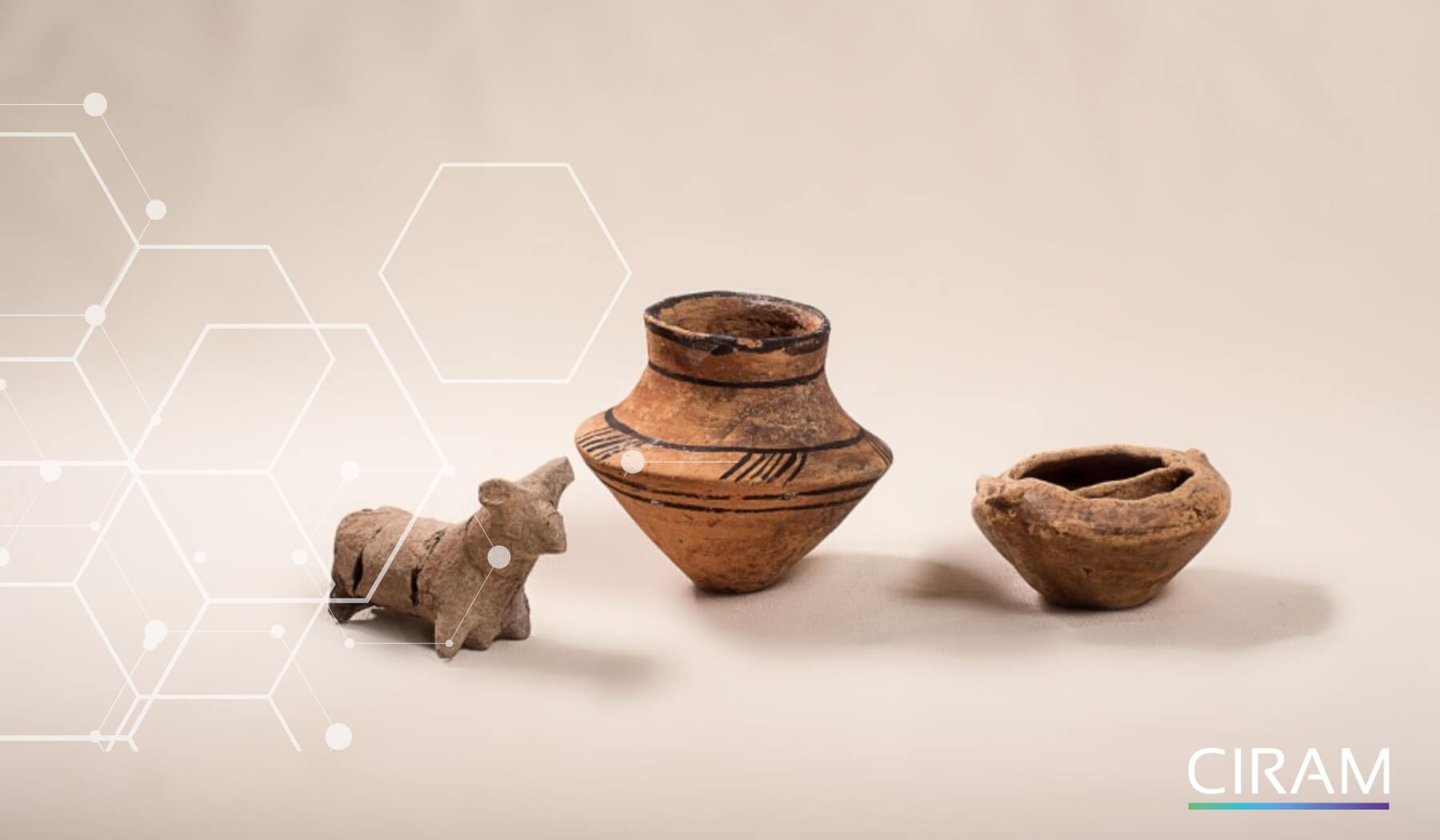

Terracotta objects made of fired clay

Thermoluminescence test (TL test) on terracotta - CIRAM

Discover CIRAM's thermoluminescence test protocols, measurements and results interpretation.

The thermoluminescence laboratory test

While dating materials is the most effective way of obtaining a chronological marker to authenticate an art object, it is important to distinguish between the event being dated and the event being dated. Thus, dating a material is not the same as dating its use by man.

Our scientists use carbon-14 dating for organic materials, but we also use other dating methods for inorganic materials. For heated objects, CIRAM uses thermoluminescence, which works on ceramics, porcelain and terracotta in general, with a chronological range of around 300,000 years.

Please note that materials such as stone, metal, glass and pigments cannot be dated. CIRAM laboratories will use analytical alternatives (electron microscope, chemical analysis...) to authenticate them.

The phenomenon of luminescence

In 1664, Boyle reported the phenomenon of heat-stimulated luminescence or thermoluminescence (TL). But its physical properties were not studied until the 1930s, thanks to the development of photomultiplier tubes. In the 1950s, the potential of thermoluminescence was explored for the dating of archaeological materials, particularly ceramics. But the application of TL to dating did not come to fruition until the mid-60s in England. It was not until 1967 that the first TL dating studies were carried out in France.

The principle of thermoluminescence

TL is based on the study of natural radioactivity and the ability of the crystals contained in a terracotta to accumulate the effects of this irradiation. This energy (also called irradiation dose) is proportional to the time the crystals are subjected to this irradiation. In other words, TL corresponds to the emission of light (luminescence) caused by a thermal (thermo) input of energy. Note that the intensity of this luminescence is proportional to the energy absorbed by the crystal, and therefore proportional to time.

TL tests are used to determine the natural radiation dose (QNat) received since time zero (i.e. the last time the material was heated). For true TL dating, two values need to be measured:

  • QNat: actual irradiation dose ;
  • I: annual radiation dose.

The TL study of objects outside their burial context does not allow for real dating. However, the QNat measurement will assess the age and provide objective information on the authenticity or otherwise of the object studied. For this purpose, we assume an annual radiation dose of between 3 and 6 mGy/year, which corresponds to the vast majority of cases encountered. This lack of annual dose measurement means that the relative accuracy of thermoluminescence age tests is of the order of 20-30% of the estimated age.

Distinction between forgeries and authentic objects

By examining thermoluminescence curves, it is possible to distinguish between modern fakes and authentic objects.

Unlike carbon-14, it is impossible to detect a significant gap between the dated event and the event being dated. Since the firing of terracotta is the last anthropogenic act recorded by the material. The relevance of the result to the problem posed leaves no room for doubt.

The thermoluminescence test

TL testing is relatively simple to perform, but the diversity of materials makes it difficult to adapt measurement protocols and interpret results. Porcelain, for example, is problematic for TL because its manufacturing process involves high-temperature firing, which results in total or partial amorphization of the material. As a result, the physical properties that condition TL operation are altered or even destroyed. In this case, the results of conventional TL will be unusable, and we will use "predose", an alternative technique.

The evolution of counterfeiters' methods, combined with their growing understanding of the analytical techniques we use, makes it increasingly necessary to use TL to detect fakes.

We'll see in a later article that thermoluminescence tests need to be combined with other investigative techniques to detect the so-called "new fakes", which are more successful.

The quest for authenticity in terracotta objects

Factual data derived from physico-chemical analysis, correlated with accumulated knowledge of the evolution of shapes and techniques, fuel the quest for authenticity.

To make a precise diagnosis, our scientists always propose a combination of clues, while remaining aware of the limits of each approach. If certainty is the absolute goal of authentication, it is rarely attainable. However, the detection of a fake will always be more obvious than the certainty of an authentic object. But thanks to our expertise and know-how, the result will always be reliable, objective and relevant.


Carbon-14 dating of wood carvings

Reading time:

4–5 minutes

Written by:

CIRAM laboratories offer carbon-14 dating for your works of art, whether made of wood, ivory, bone, wood, plant fibers... or organic matter in general.

In summary:

  • Carbon-14 dating makes it possible to date wooden sculptures and other objects made of organic materials up to about 60,000 years old.
  • Thanks to accelerator mass spectrometry (AMS), the analysis requires only very small amounts of sample.
  • In particular, this method makes it possible to distinguish between antique works and modern copies and to ensure the authenticity of art objects.
  • When combined with historical and stylistic analyses, radiocarbon dating provides essential complementary scientific evidence.

How does 14-dating work on wood carvings?

In the late 1940s, American researchers discovered how to use the properties of natural carbon-14 radioactivity to date organic matter. Carbon-14 dating was then exploited by Williard Frank Libby in the 50s on Egyptian samples.

Radiocarbon (carbon 14) dating is used to determine the time elapsed since the death of an organism. This method has revolutionized archaeology, making it possible to date artifacts made of wood, bone, teeth, textiles or even plant macroremains, up to 60,000 years ago.

How does radiocarbon dating work?

This laboratory technique is based on measuring the quantity of carbon 14 remaining in an organism. C14 is a radioactive isotope of carbon that will progressively decrease as soon as the organism dies, according to a known exponential law. It is estimated that the quantity of carbon 14 is halved every 5730 years. However, beyond 60,000 years, the quantity of carbon 14 will be too low to provide a date.

To measure radiocarbon, our scientists use cutting-edge technologies such as particle gas pedal mass spectrometry (AMS). This method is a revolution in the world of dating, since it requires very little material (1 mg of carbon compared with 1g previously), a minimum of time (around 1 hour of counting instead of several days or weeks in the past) and a more precise result.

Calibrating results

To obtain reliable and relevant data, it is important to calibrate the results based on :

  • Gross age: expressed in BP years, "before present", based on the assumption that carbon-14 concentration has been constant in time and space.
  • To obtain calibrated dates. We know that carbon-14 content has varied as a function of solar activity, climate and industrial activity. This is why we need to correct and calibrate the raw ages using calibration curves. These calibrated dates, combined with probability percentages, are used to verify the authenticity of a wooden sculpture.

Why were the results different before and after 1954?

It is possible to tell whether objects were made before or after 1954 by their carbon-14 content, but how?

This artificial "boundary" was man-made, as atomic bombs and atmospheric nuclear testing in the 50s and 60s doubled the amount of carbon-14 in the atmosphere.

In recent objects, our scientists have detected abnormally high levels of carbon 14. However, since the end of atmospheric nuclear testing in the mid-1960s, we have seen a steady decline in the quantity of C14. This phenomenon makes it possible to provide very precise dating of recent years (to within one or two years in the best case), used for dating wine, for example.

Is radiocarbon dating relevant to tribal art?

Radiocarbon dating is relevant to Tribal Art, because carbon 14 can absolutely differentiate between objects made from materials that lived before or after 1954. Carbon 14 clearly identifies copies and fakes. Moreover, this analysis is equally effective for older cultures (Dogon, Tellem, Djennenké, for example). Finally, thanks to augmented carbon 14, an innovative method developed by CIRAM and presented in a future article, we can reduce the intervals between the 18th, 19th and early 20th centuries to a few decades.

The place of science in the art market

Whether for the art market or archaeology, carbon-14 dating is a major advance. Over the years, this analysis has become a precious and indispensable tool for CIRAM laboratories.

Carbon 14 dating is particularly useful for detecting fakes in tribal art, for example.

But these scientific "tests" must be combined with a historical and stylistic study of a work. It is important to maintain a global and comprehensive approach to deliver accurate and reliable results. Carbon-14 dating should be used as an objective aid to decision-making, not as an imperative.

Share this article

Avatar by Jean-Baptiste Forget

Need more information or have a question?

Our team will get back to you as soon as possible.

Request a quote