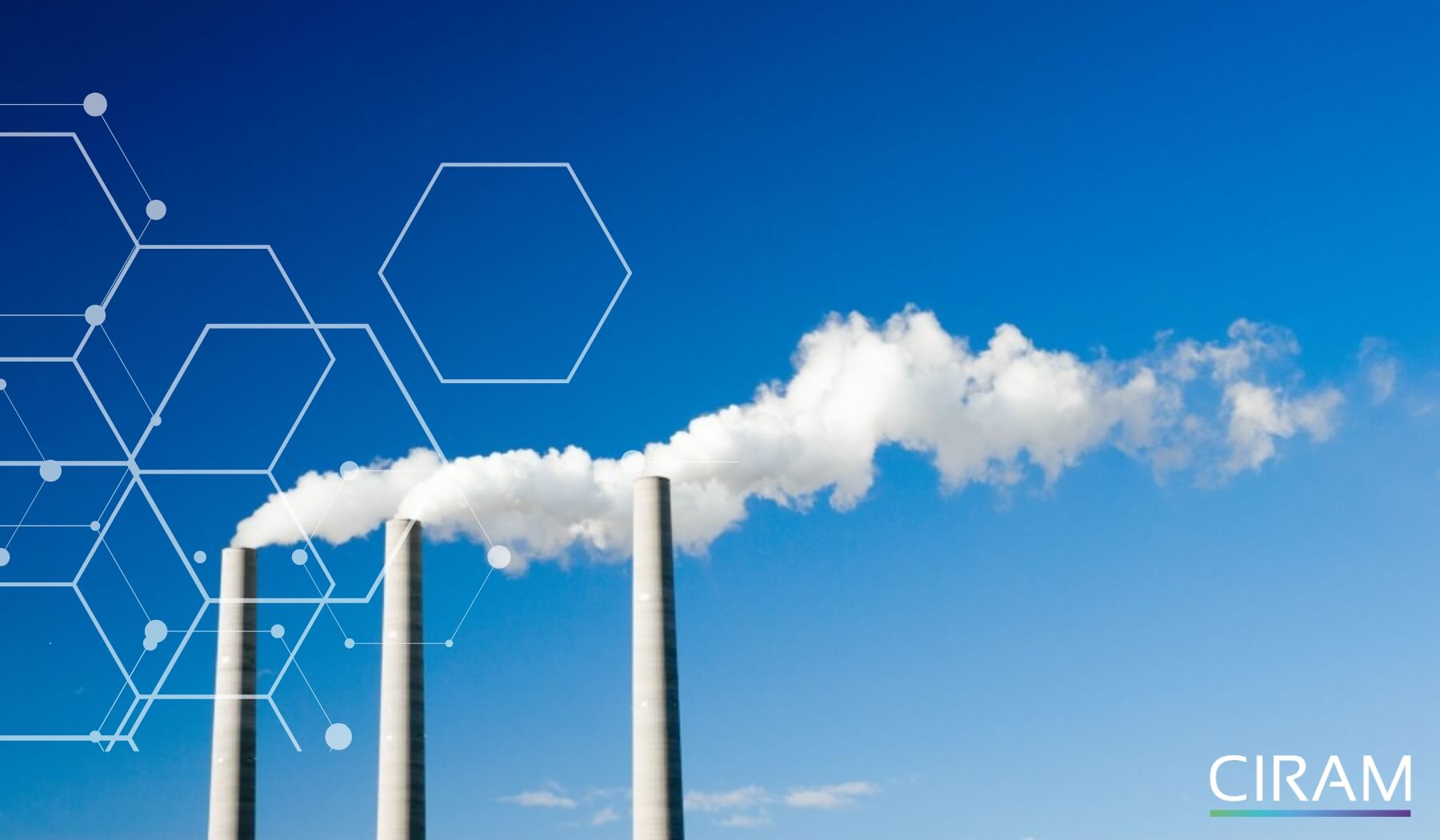

As specialists in carbon-14 analysis, CIRAM Laboratories use the (ASTM D6866 standard to provide results that comply with regulations. Learn more today about how radiocarbon contributes to the analysis of biogas, as well as industrial stack gas.
The principle of radiocarbon analysis
Visit biogas, and primarily contain carbon, hydrogen, and oxygen. It is possible to quantify these elements by elemental analysis, for example. But it is impossible to distinguish the biogenic or fossil origin of a hydrogen or oxygen atom. However, it is possible to do so for carbon. The 14 isotope of carbon is unstable, so it transforms over time. Its concentration is halved every 5730 years; this is called a "half-life." After 10 periods, carbon 14 has completely disappeared. Natural gas comes from the decomposition of organic materials over millions of years, far beyond the 10 periods of carbon 14, which is about 60,000 years. Therefore, natural gas no longer contains carbon 14. Conversely, current biomass has a full reserve of carbon 14, which is referred to as "modern carbon." Radiocarbon analysis is used to quantify the proportion of bio-based or biogenic (modern) carbon and the proportion of fossil (ancient) carbon present in biogas.
Carbon-14 fume analysis
Depending on the fuel burned, chimney flue gases will contain varying amounts of biogenicCO2. CIRAM laboratories analyze the CO2 in chimney flue gases using radiocarbon dating in accordance ASTM D6866 standard.
By measuring carbon-14 concentration, CIRAM determines the percentage of biogenic carbon in relation to carbon of fossil origin. Two types of carbon are distinguished with :
- Materials containing biogenic carbon (rich in carbon 14). This includes wood, paper and biomass of animal or plant origin.
- Materials containing fossil carbon (low in carbon 14), i.e. coal, oil or natural gas.
Measurements can be taken directly on a smoke sample collected at the chimney outlet. CIRAM laboratories use special bags to collect CO2 on site. Fine particles can also be sampled from filters installed on industrial chimneys.
A system dedicated to biogas and flue gas analysis thanks to CIRAM laboratories
CIRAM has developed a dedicated system for biogas and flue gas analysis. This system is directly connected to the automatic graphitizer. The gas is not injected into the elemental analyzer, as it is for solids and liquids, but passes through a "sulfur trap". It is vital to trap the sulfur before graphitization, as sulfur is a graphitization inhibitor. The gas, once purified, will be transformed into graphite (pure carbon) by the graphitizer.
Note that this system does not provide elemental concentration or stable isotopic information, as the gas is injected directly into the graphitizer without passing through the EA-IRMS.
CIRAM laboratories, specialists in carbon-14 dating
CIRAM laboratories take radiocarbon measurements of your biofuel samples in general, and biogas samples in particular, as well as industrial flue gases to determine the percentage of biogenic material they contain.
Carbon-14 analysis is possible not only on gas, but also on liquids and solids. CIRAM complies with the ASTM D6866 standard for the study of your biogas, in order to provide you with reliable and precise expertise.
ASTM D6866 is the reference standard for the analysis of biofuels and biogas using the carbon-14 technique. Our engineers interpret the results in the laboratory, and provide full results within 10 working days.