
Article Outline
- Specific features of carbon-14 dating of mummies
- Type of samples to be analyzed
- Mummy-specific challenges
- Advanced carbon-14 dating methodology applied to mummies
- Sample preparation and extraction
- Key laboratory steps
- Case studies in mummy dating
- Egyptian mummies: dating burial bandages
- Andean mummies: the challenges of extreme environments
- Complex cases: modern contaminations
- New approaches: dating funerary textiles
- Natural mummies: challenges and opportunities

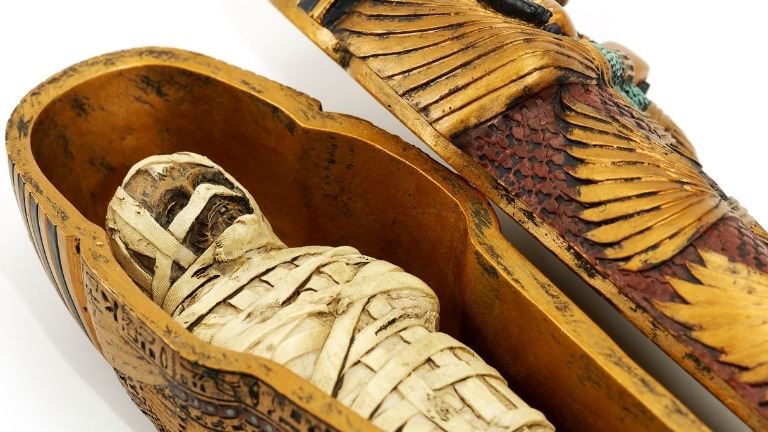
The dating mummies is an essential analysis that allows archaeologists to accurately reconstruct the history of ancient civilizations. Among the various archaeological dating methods, thecarbon-14 dating establishes itself as an essential tool for researchers. However, its application to mummies often raises methodological challenges such as sample selection, contamination risks, chronological limits, and the necessary corrections to guard against them.
In this article, we explore in detail the radiocarbon dating process : its specificities applied to Egyptian and Andean mummies but also the scientific solutions at our disposal that allow us to optimize the carbon-14 dating accuracy of mummies. Finally, we will see how specialized laboratories, such as CIRAM supports, play a key role in the activities archaeological and the dating.
In summary:
- Carbon-14 dating is a standard method for determining the age of mummies and gaining a better understanding of ancient civilizations.
- Sample selection and the elimination of contaminants are essential to ensuring reliable results.
- Laboratory analyses (AMS, isotopic analysis, calibration) make it possible to obtain precise dates despite the limitations associated with mummified materials.
- Specialized laboratories such as CIRAM assist researchers in the study and scientific dating of mummies.
Specific features of carbon-14 dating of mummies
Radiocarbon dating carbon-14 is an essential analysis method to help archaeologists establish the timeline of mummiesHowever, archaeologists need to guarantee reliable results, and several technical and methodological issues arise for them. Among these, sample selection, contamination, and isotopic biases are challenges to overcome.
Type of samples to be analyzed
To carbon-14date a mummy, researchers need to take samples of the organic material present. The main samples at their disposal are :
- Mummified biological tissues : skin, hair, tendons or bones.
- Mummy bandages : often made of linen, an organic material that can be directly used for analysis.
- Biological residues : dried fluids, pigments applied to the body, or embalming resins. However, their use can pose problems for dating.
Visit mummy hair constituent un matériau particulièrement intéressant dans le cadre d’une to carbon-14 dating due to their resistance to degradation. A study demonstrated that a specific protocol allowed for the extraction of keratin from the hair cortex and required only about twenty milligrams of sample, which minimizes the impact on the mummy's integrity while providing precise dates. This technique is particularly well-suited for mummies preserved in museums.
Mummy-specific challenges
Although there are a variety of analyzable samples on a mummy, several factors complicate carbon-14 14 :
- Modern contamination exposure to recent preservatives (varnishes, resins, bitumen) can distort the ratio measurement ¹⁴C/¹²C.
- Conservation environment : the development of micro-organisms could artificially rejuvenate dating, if they are not strictly eliminated.
- Aging of organic material : poor preservation could prevent the collection of enough material for accurate dating.
A study conducted on the Golden Mummy of Dunkirk has shown that sample selection and chemical pretreatment are crucial to ensuring the reliability of the results. The process of selectively extracting keratin from the hair made it possible to eliminate exogenous materials and obtain a reliable date.
We will therefore explore the specific methods applied to mummies in order to cover the unique aspects of this subject of analysis.
Advanced carbon-14 dating methodology applied to mummies
The reliability of a dating of mummy to carbon-14 relies on a rigorous protocol for sampling, preparation, and laboratory analysis. Each step aims to eliminate possible biases and ensure optimal accuracy despite the inherent challenges of ancient materials.
Sample preparation and extraction
Carbon-14 dating requires meticulous sample preparation. This involves several crucial steps:
- Mechanical and and cleaning : this refers to chemical pre-treatment techniques (ABA method: acid-base-acid) to remove modern contaminants.
- Selection of the most reliable fractions : mummified hair is preferred as it offers better resistance to environmental alterations.
- Isotope filtering : analysis of carbon isotope ratios to detect any anomalies.
Key laboratory steps
C14 analysis relies on precise laboratory steps to guarantee reliable and scientifically robust results:
- Measuring the ¹⁴C/¹²C ratio : gas pedal mass spectrometry (AMS) can analyze very small samples.
- Isotopic bias control : are adjustments to account for natural isotopic fractionation.
- Calibration of results : based on IntCal 20 or SH Cal20 calibration curves, essential for correcting historical carbon-14 fluctuations.
Case studies in mummy dating
Egyptian mummies: dating burial bandages
Visit linen bandages that encase Egyptian mummies, offer excellent reliability for carbon-14 dating. A study carried out on New Kingdom mummies has confirmed their belonging to the XVIIIᵉ dynasty thanks to gas pedal mass spectrometry (AMS). This technique enables very small samples to be analyzed, minimizing the impact on the mummy's integrity.
A remarkable example is that of the Nesi-Khons mummy, having been dated between 4ᵉ and 1ᵉʳ centuries BC. The strips from this mummy contained not only an Etruscan text in linen, but also a papyrus from the Egyptian Book of the Dead, offering a unique opportunity to cross-reference textual data with carbon-14 dating.
Andean mummies: the challenges of extreme environments
A recent study of mummies discovered in the Argentinian Andes used an innovative approach: researchers counter-dated the lice nits found on the mummies' hair. This method made it possible to estimate the age of these mummies at between 1300 and 2300 years, while providing valuable genetic information on the mummified individuals.
Complex cases: modern contaminations
Some mummies were treated during the XIXᵉ century with modern substances. To counteract such contamination and achieve reliable dating, scientists must thoroughly clean samples before analysis in order to obtain usable results. The case of the mummy of Ramses II is a perfect illustration of the problem of contamination.
New approaches: dating funerary textiles
Thestudy of funerary textiles, notably at El Deir in Egypt, has opened up new perspectives for dating mummies. Researchers have been able to identify different types of textiles, including new linen strips and everyday fabrics. This approach, using reference material, not only makes it possible to date mummies, but also to obtain information on the funerary practices and social status of the deceased.
Natural mummies: challenges and opportunities
Visit natural mummies, bodies formed under particular environmental conditions that ensure their preservation, present unique challenges for dating.
For example, the preserved bodies in the permafrost or peat may have absorbed some old carbon what falsifies the results of carbon-14 dating. In these specific cases, scientists combine several methods beyond C14 dating, such as pollen or wood analysis, to obtain reliable dates.
The to carbon-14 dating remains the reference method for establishing the timeline of mummies, but it requires rigorous protocols to avoid contaminations and bypass the isotopic bias. The contribution of specialized laboratories, such as CIRAM supports, is thus essential for refining results and contextualizing the history of ancient civilizations. The ability of dating laboratories combining different analysis techniques allows researchers to accurately determine the age of mummies. Archaeologists can thus benefit from theintegration of complementary techniques, ensuring even greater precision in thestudy of ancient organic remains. If you have a problem related to the analysis of a sample from a mummy, contact our teams from now on to benefit from their expertise.
Share this article

Related topics

Need more information or have a question?
Our team will get back to you as soon as possible.