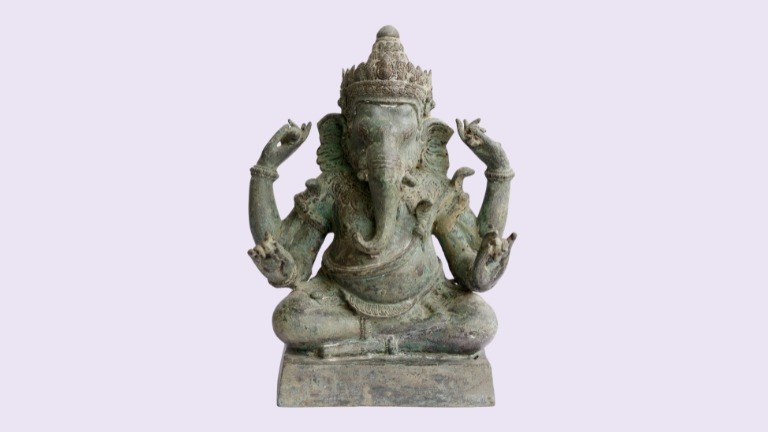

Article Outline
- Why recognizing an authentic bronze can no longer rely solely on the expert's eye
- Visual clues to antique bronze: patina, color, weight, sonority
- The limits of visual analysis in the face of modern copies and restorations
- The contribution of scientific analysis to authenticating and dating an antique bronze
- Microanalysis, the key to understanding the composition of bronze
- Microscopes and Corrosion: Understanding the Age and Authenticity of a Bronze
- Metallographic microscopy: reading metal structure
- Scanning Electron Microscopy (SEM): Observing Corrosion
- Analysis of the degree and origin of corrosion
- Laboratory analysis of antique bronzes: a decisive step for art market professionals
- Why have your bronze objets d'art analyzed by a laboratory like CIRAM?
- Integrate scientific results into a professional approach

For collectors and art market professionals, authenticating an antique bronze is a real issue of value, confidence and heritage preservation. With the rise of modern reproductions, often produced with remarkable skill, professionals can no longer rely on visual expertise or intuition, however accurate.
To avoid these risks, it is imperative to know how to verify the authenticity of a bronze. This now requires a rigorous approach, combining historical knowledge with cutting-edge scientific analysis. Art specialists generally focus on style, weight and patina to evaluate a piece, but only a specialized laboratory can validate authenticity.
In this article, we'll explore the physical and traditional criteria for identifying a bronze. We'll then look at how scientific analysis techniques offer concrete, datable and documentable proof. Finally, we will highlight the key role played by laboratories like CIRAM in supporting art professionals, between expertise, security and enhancement of works.
In summary:
- Visual clues (patina, color, weight, or sound) are helpful, but not sufficient to authenticate an ancient bronze.
- Scientific analyses make it possible to reliably determine a work of art’s composition, method of creation, and age.
- They provide objective evidence to support appraisals, sales, restorations, and insurance claims.
- A specialized laboratory such as CIRAM assists professionals in the art market with the authentication and valuation of bronze sculptures.
Why recognizing an authentic bronze can no longer rely solely on the expert's eye
The art market is a system in which each piece has an important patrimonial and financial value. Thus, theidentification of a bronze cannot be limited to the intuition or experience of an expert, however respectable.
Visual clues to antique bronze: patina, color, weight, sonority
The natural patina that has developed slowly over time offers shades of verdigris, deep browns and golden highlights, rarely matched by artificial processes.
The weight and density of the object are also useful indicators. An antique bronze generally has a density of around 8,600 kg/m³. If a piece weighs too little for its volume, this is a sign that a poorer alloy or a substitute material (regal, resin) has been used to make it. The magnet test (albeit empirical) is sometimes used to rule out modern ferrous alloys. Finally, the clearer, more crystalline sound of a genuine bronze, obtained by striking the metal, can offer a further indication of a counterfeit.
The limits of visual analysis in the face of modern copies and restorations
However, the methods described above have major limitations. Today's market is flooded with sophisticated reproductions, sometimes cast from period molds, with an artificial patina applied by specialized craftsmen. Even old restorations can be confusing, as they may mix original elements with materials added later.
Even experts can't rely solely on their own eyes or experience when faced with this level of uncertainty. To recognize an antique bronze with accuracy, it becomes necessary to resort to reliable scientific analysis, capable of accurately determining the chemical composition, the internal structure of the metal, or even the origin of corrosion. These elements are indispensable and constitute tangible proof to authenticate an antique bronze and differentiate it from a recent copy, however convincing it may be.
The contribution of scientific analysis to authenticating and dating an antique bronze
Scientific tests are becoming essential for the objective identification of a bronze when visual expertise is no longer sufficient. They provide verifiable and documentable data for professional bronze appraisal.
Microanalysis, the key to understanding the composition of bronze
Analysis of the chemical composition of an antique bronze object is often the first lever for authentication. It allows us to determine the exact nature of the metallic elements present in the alloy: copper, tin, lead, zinc or even traces of arsenic. However, the content of these elements varies significantly according to period, region and casting technique.
For example, the detection of arsenic in significant proportions may indicate arsenic copper, used in antiquity before the widespread use of bronze. This historical variant is therefore a valuable marker for dating and attributing an object to a given era. Conversely, high levels of zinc may indicate brass, and aluminum a modern bronze.
Thanks to microanalysis coupled with EDX spectrometry, it is possible to identify the elemental composition of a sculpture. This data can be used to differentiate an antique bronze from an industrial alloy that is too pure, proof of a standardized object.
These results can be cross-referenced with scientific databases to situate the piece in its historical and geographical context.
Microscopes and Corrosion: Understanding the Age and Authenticity of a Bronze
After analyzing the chemical composition of the bronze in question, an examination of the metal’s internal structure and its state of corrosion allows for a more in-depth assessment. These observations provide valuable clues about the manufacturing processes and the artifact’s true age. Laboratories conduct several types of analysis:
Metallographic microscopy: reading metal structure
Metallographic microscopy is a technique based on the observation of polished micro-sections revealed by chemical etching. It enables in-depth analysis of the metal's internal structure:
- Granulometry and dendrite size (indices of cooling)
- Traces of hammering or manual shaping
- Presence of phases metallurgical related to tin content
Microscopy scanning electron microscopy (SEM): observing corrosion
Scanning electron microscopy (SEM) provides an extremely precise view of the metal surface. It is particularly useful for studying corrosion layers:
- Visualization of stratification, crystallizationand oxidation products
- Identification of natural corrosion (slow, complex development)
- Detection of artificial corrosion (recently applied chemical patina)
Distinguishing the type of corrosion is essential to validate or invalidate authenticity. Modern patinas, even sophisticated ones, often leave traces that can be detected by SEM, unlike ancient alterations caused by burial or prolonged exposure.
Analysis of the degree and origin of corrosion
A corrosion test, combined with the SEM, is used to evaluate :
- Thethickness of corrosion layers
- Their chemical composition
- Their environmental origin (damp soil, marine atmosphere, indoor storage…)
These elements provide clues as to the actual age of the bronze and the conditions under which it was preserved or buried. Heterogeneous, deep, natural corrosion is often the hallmark of an old piece. Homogeneous, superficial or overly "perfect" corrosion, on the other hand, may indicate a modern reproduction with a chemical patina.
The combination of these techniques - EDX microanalysis, metallographic microscopy, SEM and corrosion studies - results in a complete, traceable and opposable scientific expertise. These methods provide objective proof of a bronze's composition, manufacture, age and origin.
It's a reliable methodology for securing a sale or enhancing the value of a work of art. The CIRAM laboratory, as a specialist in antique materials, masters all these methods and supports art market professionals with rigorous reports that can be used in these contexts.
Laboratory analysis of antique bronzes: a decisive step for art market professionals
Selecting and carrying out analyses is only the first step in the authentication process. Interpretation of the results is essential to enhance the value of antique bronzes and to integrate them into an overall appraisal or sales process. It is here that specialized laboratories bring their full value to art market professionals.
Why have your bronze objets d'art analyzed by a laboratory like CIRAM?
The intervention of a recognized art laboratory like CIRAM is essential to authenticate an antique bronze. It offers a double guarantee: scientific rigor and credibility on the art market. The analysis reports produced will include all the necessary techniques: EDX microanalysis, metallographic microscopy, study of the degree and origin of corrosion, and even X-rays if the object allows.
CIRAM supports has also mastered the detection of historical alloy variants, such as arsenic-bearing coppers or tin-rich bronzes, and can identify the metallurgical phases useful for dating and situating objects in their period.
The laboratory works on a regular basis with legal experts, auctioneers, insurers and heritage institutions, enabling analyses to be calibrated according to the real need: purchase, sale, restoration, legal appraisal or insurance.
Integrate scientific results into a professional approach
A scientific analysis of a bronze work of art is only of value if it can be understood, used and shared with other stakeholders. Expert laboratories present the results in a clear report, with photographs, protocols, interpretation and conclusions. This helps to secure an acquisition, justify a sale, or structure a restoration file in compliance with museum standards.
In some cases, metallurgical analysis can also be used to date the object's manufacture, notably by comparing the results with major historical and archaeological databases.
Finally, scientific analysis plays a dissuasive role in the fight against counterfeiting, by defining documented traceability, which can be integrated into a certificate of authenticity or an insurance inventory. For a professional, integrating this approach means using science as a lever of trust and added value.
Recognizing an authentic antique bronze can no longer be based simply on a specialist's visual appraisal, however serious this may be. Scientific analyses such as microanalysis, EDX, metallographic microscopy and other corrosion studies provide tangible, dateable proof in response to buyers' uncertainties. The results of these analyses, and their presentation in authentication files, secure transactions, enhance the value of works and provide professionals with essential traceability.
As a leading laboratory in scientific analysis and dating, CIRAM supports professionals in the art market with proven methods, including dating techniques (carbon-14, TL/OSL), imaging techniques (X-ray radiography, infrared imaging, CT scans, UV fluorescence), and characterization techniques (metallography, PIXE, chromatographic analysis)…
Would you like to authenticate a bronze, verify its composition, or determine its age? Request a customized analysis by contacting us via our contact form!
Share this article

You might be wondering about these things regarding bronze objects?
Yes. Many ancient bronze sculptures have undergone restoration, repairs, or additions over the course of their history. These modifications may affect certain parts of the object, the patina, or structural elements. This is why a scientific analysis must take into account the material history of the work in order to distinguish the original elements from more recent interventions.
Yes, scientific analysis can provide important information even in the absence of comprehensive historical documentation. The study of materials, manufacturing techniques, and signs of deterioration helps establish a body of evidence regarding the period and conditions under which an object was created. However, provenance information remains essential for placing the work within its historical context.
The composition of bronze varies depending on the period, region, available resources, and techniques used by foundry workers. Two contemporary objects may therefore consist of different alloys. This is why the interpretation of a chemical analysis is never based on a single element, but rather on a comparison with historical and archaeological references.
Dating seeks to determine the period during which a material was produced or used, while authentication aims to establish whether an object is indeed the work, by the artist, or from the period to which it is attributed. Scientific analysis can contribute to both processes, but they do not address exactly the same question.
Related topics


Need more information or have a question?
Our team will get back to you as soon as possible.